
Nov 20
/
Amy Parkinson
Making EMG education more accessible: our collaboration with the De Luca Foundation
Widening access to Learn EMG
The De Luca Foundation is supporting free access to MyoLearn’s Learn EMG programme for its global community, creating another route for people who want to build their understanding of surface electromyography.
Learn EMG brings together six foundational modules covering the physiological, anatomical and biomechanical principles behind the signal, through to systems and settings, data collection, processing and analysis. The supported package also includes 12 months of MyoLearn membership, providing continued access to practical tools, research resources and the wider MyoLearn learning environment.
If you are interested in accessing Learn EMG through the initiative, you can register your interest with the De Luca Foundation.
A shared aim: widening access to EMG education
The De Luca Foundation has supported the biomechanics research community since 1985. Its work includes research and travel grants, public education and workshops, alongside a wider mission to support students and researchers, foster innovation and advance research in EMG and human movement sciences. MyoLearn complements that broader mission through education. Our aim is to bring structured EMG learning, evidence and practical resources together, helping people understand the science behind the signal and develop the knowledge needed to apply it appropriately. That shared interest in widening access to high-quality EMG knowledge is what sits behind this collaboration. The need for it becomes clearer when we look at how differently people around the world are able to access EMG education and practical experience.
Access to EMG education can look very different
Surface EMG has been used across research, rehabilitation, movement science and human performance for decades. The research base surrounding it is substantial and the technology continues to evolve. But having access to an EMG system and having the knowledge to use it well are two different things.
Where and how someone learns EMG can vary considerably. Some are introduced to it through specialist biomechanics or movement science programmes, with access to laboratories, experienced researchers and opportunities to apply their knowledge in practice. Others may encounter it briefly within a wider healthcare, engineering or sport science course, while some only begin learning about EMG when a research project or practical problem requires it. Campanini and colleagues (1) identified wide variation in training around quantitative and electrical measurements, alongside differences in educational programmes and academic opportunities. They also highlighted gaps in areas such as mathematics, physics and signal interpretation as potential barriers to using surface EMG effectively. In practice, opportunities to build EMG knowledge and practical experience can look very different depending on where someone studies or works.
In some higher-resource settings, specialist laboratories, established research groups and formal training provide relatively strong routes into EMG. In other settings, learners may have fewer opportunities to access the same infrastructure, expertise and practical experience. Research from individual countries helps illustrate what those differences can look like. In Chile, Manzur-Valdivia and Alvarez-Ruf (2) examined eight physical therapy curricula. Five included some EMG-related content, but none of the clinical or internship courses they reviewed mentioned EMG. Interestingly, the same study identified several systems that met the authors’ criteria for portability, affordability and ease of use, suggesting that hardware availability alone would not necessarily address the training gap.
Medved and colleagues (3), writing largely about Croatia, described situations where EMG measurement and analysis formed part of physiotherapy education, but limited laboratory facilities meant some signal-processing methods were demonstrated rather than practised directly by students. And more recently, an Opinion article by Gupta and Aggarwal (4), written from an Indian physiotherapy perspective, argued for stronger integration of EMG education, including practical teaching around sensor placement, signal acquisition, processing, interpretation and sources of error. These examples are not a complete picture of EMG education globally. They do, however, illustrate an important point: access to knowledge, equipment and practical experience do not always develop at the same pace.
More than one route into specialist knowledge
Formal teaching, laboratory experience, mentorship, workshops, research projects and professional development all have important roles in learning EMG. But they do not have to be the only routes into specialist knowledge.
In 2018, De la Fuente and colleagues (5) ran a free three-day Winter School on EMG signal processing in Brazil for 50 participants, aimed at reducing educational barriers in Latin America. The programme combined theoretical and practical learning, was delivered in Portuguese and Spanish, and its lectures were later made freely available online. The authors suggested that combining educational activities with continued online access could reinforce learning and reduce some educational barriers. They also proposed that fully online provision could allow similar opportunities to reach larger numbers of students and professionals.
Online education cannot recreate every aspect of practical experience, nor should it try to replace universities, laboratories, mentors or hands-on teaching. What it can do is provide another route into specialist knowledge. Learners can revisit difficult concepts, progress at their own pace and access education that may not otherwise be readily available through their institution, workplace or location. This is where MyoLearn’s collaboration with the De Luca Foundation can make a practical difference: widening free access to Learn EMG so more people can build those foundations, regardless of where their learning starts.
From understanding the signal to applying it
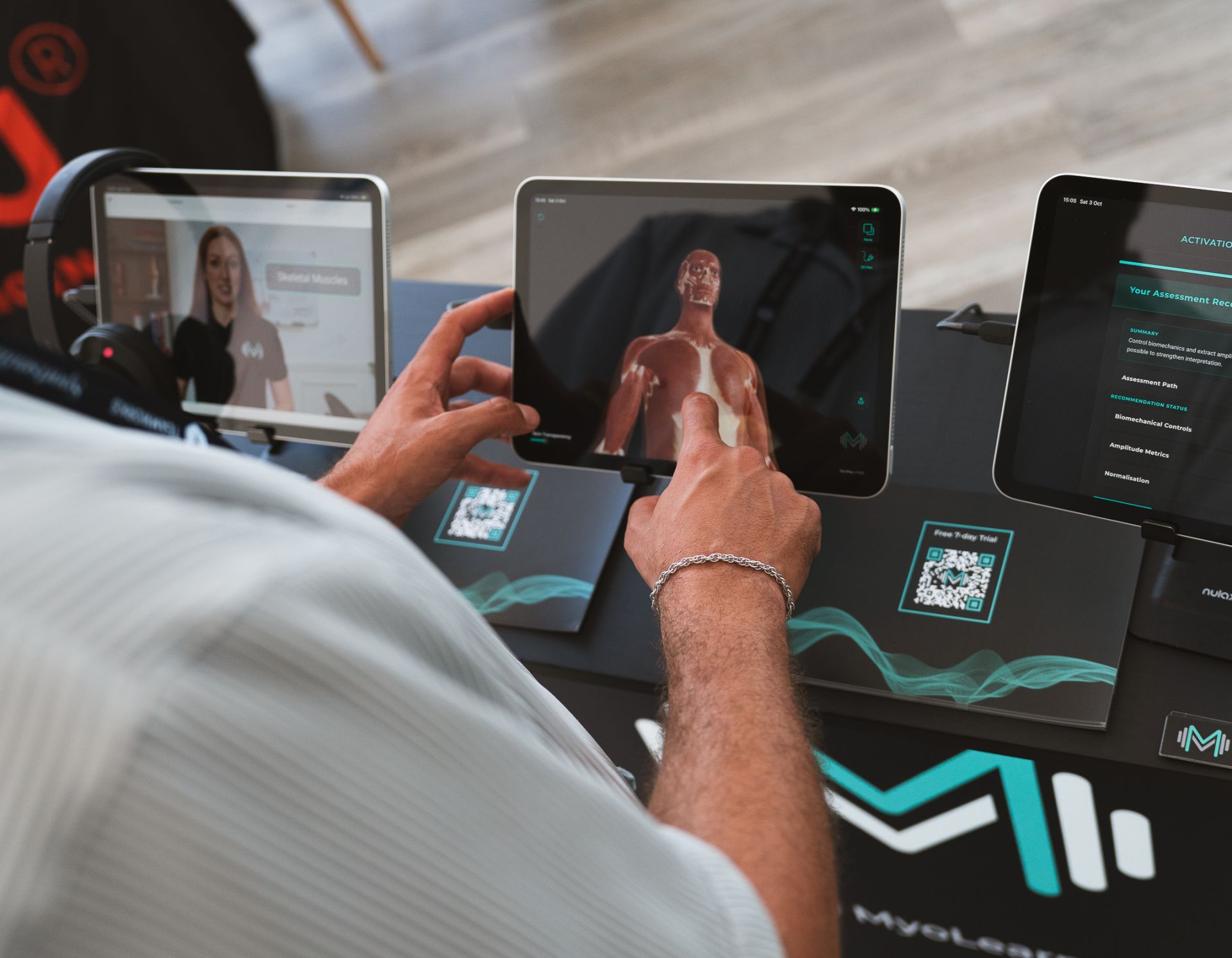
Collecting an EMG signal is only the beginning. Understanding what that signal represents, how physiological, anatomical and biomechanical factors influence it, how decisions around data collection and processing affect the result, and what can reasonably be concluded from the data all require knowledge. MyoLearn developed Learn EMG to bring those foundations together in a structured pathway. Across six modules, learners progress from understanding where the EMG signal comes from and what influences it through to preparing for data collection, recording, processing and analysis. The supported package also includes 12 months of MyoLearn membership, giving learners continued access to MyoMap, MyoLibrary, MyoTools, the MyoLearn Community and regular blog and news content.
The intention is not simply to provide more information when there is already a wealth of EMG information available. It is to bring structured, evidence-based education and practical resources together in one place, making it easier for people to build their understanding and continue developing it over time.
One thing to take away
Access to EMG technology and access to EMG knowledge are not the same thing. Different learners around the world face different barriers, and online education cannot remove all of them. But it can create more opportunities to access specialist knowledge and build the foundations needed to use EMG appropriately. Through this initiative, MyoLearn and the De Luca Foundation are working together to widen access to structured, evidence-based EMG education. Together, we hope more people across the global EMG community have the opportunity to understand the science, build practical knowledge and develop confidence in applying EMG.
Interested in accessing Learn EMG?
The De Luca Foundation is supporting free access to MyoLearn's full Learn EMG package, including six foundational modules and 12 months of MyoLearn membership. If you'd like to build your understanding of surface EMG, register your interest through the De Luca Foundation.
References
1. Campanini I, Disselhorst-Klug C, Rymer WZ, Merletti R. Surface EMG in Clinical Assessment and Neurorehabilitation: Barriers Limiting Its Use. Front Neurol. 2020;11:934.
2. Manzur-Valdivia H, Alvarez-Ruf J. Surface Electromyography in Clinical Practice: A Perspective From a Developing Country. Front Neurol. 2020;11:578829.
3. Medved V, Medved S, Kovač I. Critical Appraisal of Surface Electromyography (sEMG) as a Taught Subject and Clinical Tool in Medicine and Kinesiology. Front Neurol. 2020;11:560363.
4. Gupta S, Aggarwal S. Strategies for STEM and SEMG applications in clinical practice—lessons from the past. Front Rehabil Sci. 2024;5:1500316.
5. De la Fuente C, Machado ÁS, Kunzler MR, Carpes FP. Winter School on sEMG Signal Processing: An Initiative to Reduce Educational Gaps and to Promote the Engagement of Physiotherapists and Movement Scientists With Science. Front Neurol. 2020;11:509.
Evidence-based education and interactive resources for understanding and applying surface EMG.
Copyright © 2026
MYOLEARN
FREE 7-DAY TRIAL
Ready to explore MyoLearn?
Discover how MyoLearn can help you build confidence in surface EMG with evidence-based, expert-led education.
-
Explore selected EMG classes
-
Discover interactive learning tools
-
Connect with other learners
No payment details required. No commitment.